

Red vs DropTail Queue Management in 5G-like Networks Using NS-3, 5G LENA, and NetAnim
This study integrates bulk RNA-seq, single-cell atlases, and cell–cell communication analysis to show that the large “UNKNOWN” fraction in ccRCC deconvolution represents misclassified malignant tumor cells, highlighting key limitations of reference-based methods and the need for tumor-inclusive models.
Our motivation
Our motivation is rooted in understanding how complex distributed systems behave under real-world constraints. Modern infrastructures, whether wireless networks, cloud platforms, or large scale computational pipeline operate with limited bandwidth, variable workloads, and competing resource demands. By studying system level behavior under stress, we aim to uncover bottlenecks that are often invisible in aggregate metrics but critical for long term efficiency and reliability.
Our vision
Our vision is to design scalable, performance-aware distributed systems that intelligently balance computation and communication. We aim to contribute to next-generation wireless and cloud architectures that proactively manage congestion, optimize latency, and adapt dynamically to workload variability. Ultimately, we seek to build resilient infrastructures capable of supporting data-intensive applications without sacrificing efficiency or robustness.
Output
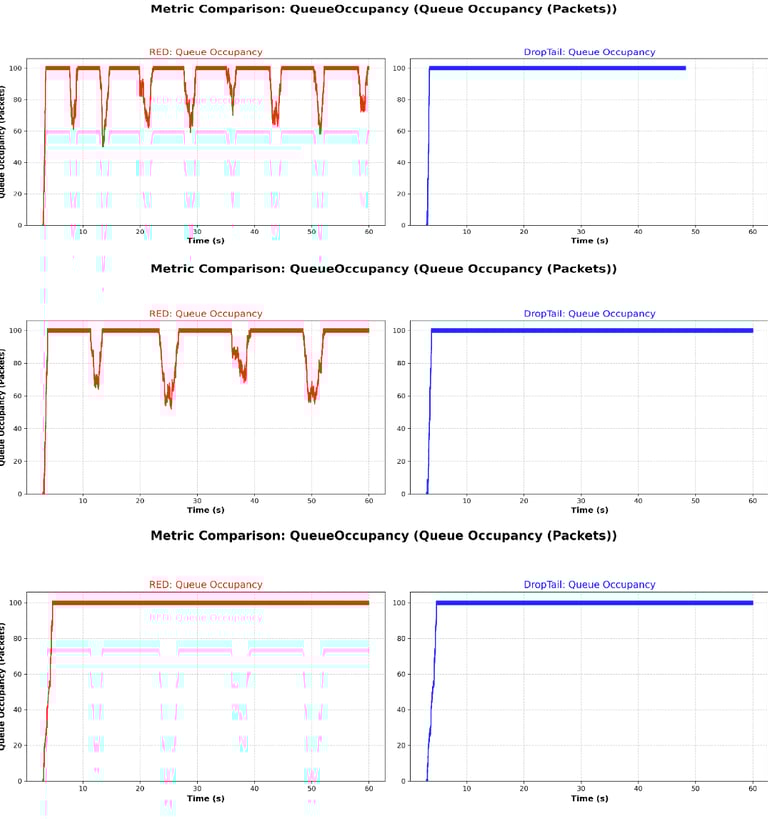
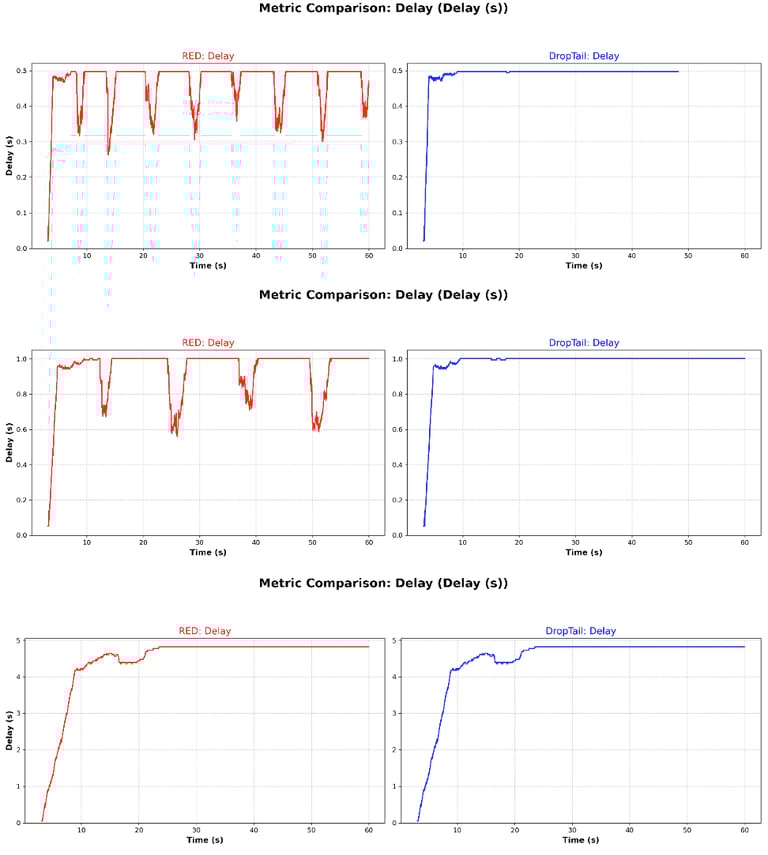
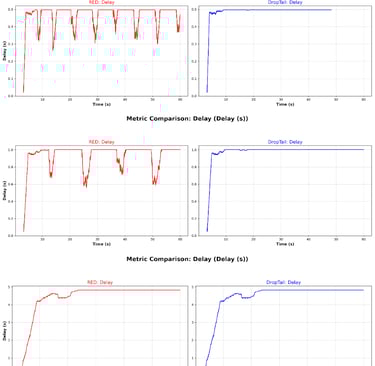
The simulation results demonstrated clear behavioral differences between DropTail and RED under constrained 5G backhaul conditions. While aggregate FlowMonitor statistics showed comparable throughput and packet loss, time-series tracing revealed that DropTail rapidly saturated the queue and maintained persistent buffer occupancy, leading to consistently high delay. In contrast, RED introduced early probabilistic drops that prevented prolonged saturation, producing a characteristic sawtooth pattern in queue occupancy and delay. This periodic queue clearing reduced average delay and jitter across all tested backhaul capacities (1 Mbps, 500 kbps, and 100 kbps). Although RED occasionally exhibited sharper jitter spikes, its ability to mitigate sustained congestion resulted in superior overall performance in high-rate 5G traffic scenarios.
Tools Used
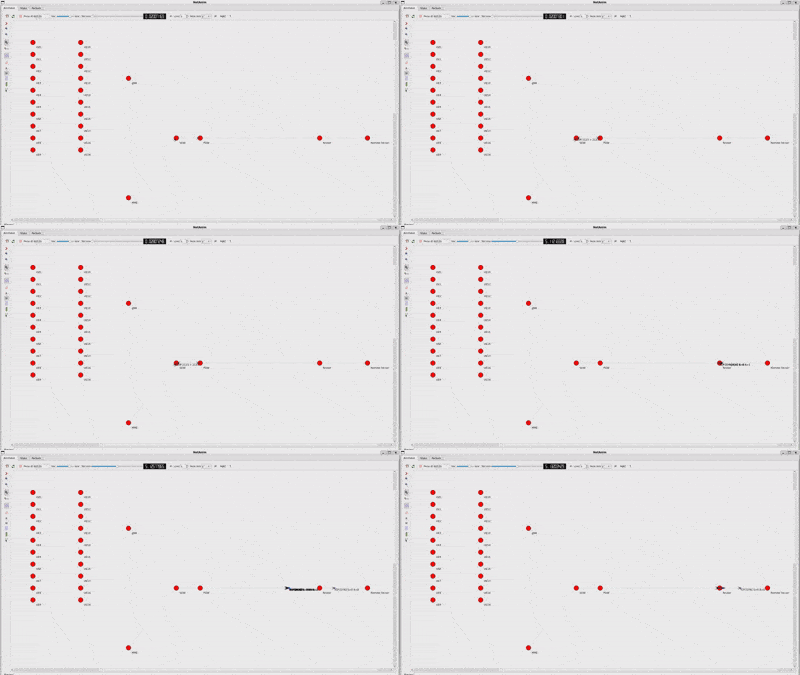
The simulation environment was implemented using ns-3 with the 5G-LENA module to model realistic 5G network behavior and backhaul constraints. Performance metrics such as throughput, packet loss, and delay were collected using FlowMonitor, while custom queue tracing was implemented to capture time-series buffer occupancy and congestion dynamics. The experiments were developed and executed in a C++-based simulation framework, with post-simulation analysis performed using Python for data processing and visualization.
Observation
The analysis focused on comparing queue dynamics and performance trade-offs between DropTail and RED under varying backhaul bandwidth constraints. While both mechanisms maintained comparable throughput levels, their internal congestion behavior differed significantly. DropTail exhibited rapid queue saturation and prolonged buffer occupancy once the bottleneck link was reached, resulting in sustained high delay and increased latency variance. In contrast, RED introduced early probabilistic packet drops, preventing persistent queue buildup and producing cyclical queue behavior that stabilized average delay. Time-series queue tracing revealed that RED reduced long-term congestion accumulation, particularly under higher traffic loads. These findings highlight how early congestion signaling mechanisms can improve latency performance in high-throughput 5G environments, even when aggregate throughput remains similar.
Conclusion
This study compared DropTail and RED under constrained 5G backhaul conditions using ns-3. While both mechanisms maintained similar throughput, their congestion behavior differed significantly. DropTail quickly saturated the buffer and sustained high delay once the bottleneck was reached. In contrast, RED applied early probabilistic drops, preventing prolonged queue lock-in and reducing long-term delay, though with increased jitter variability. Overall, the results demonstrate that proactive congestion control mechanisms like RED provide improved latency management in high-throughput 5G environments compared to reactive approaches such as DropTail.